
Based on our belief that a company grows through respect for people and the growth of people, we strive to create the best possible working environment through measures such as enhancing our human resources cultivation systems. These measures enable all human resources to perform at their full potential, and to feel a sense of motivation and fulfillment during their work.
Human Resource Management
MAX's Concept of Human Resources
Basic Policy on People
Our corporate color, "Human Red," visually represents our spirit of respect for people, signifying personal warmth and growth. In keeping with this spirit, we aim to be lively and fun, and have established the Basic Policy on People.
Basic policy |
"Management that believes in people and brings out their best" MAX believes that by respecting people, the development of people will result in growth for the company. |
Our ideal personnel |
"People who are willing to keep taking on new challenges without fear of failure and who are willing to learn and grow with others." 1.People who trust others and are trusted by others; people who are worthy of trust 2.People who think things through and step forward 3.People who take the lead and can work well in a team 4.People who take facts as a shared value, who gather public information, and make the unknown known 5.People who have a spirit of being a half a step ahead, who use their work for endless self-growth 6.People who have a wide range of knowledge and expertise as global talent and who never stop trying new approaches |
Personnel policies and management policy |
Respect for human rights, personality, and individuality In the spirit of respect for people, we respect the human rights, personality, and individuality of everyone. Personal growth as a foundation We aim to realize co-learning, through which workers grow together. We invest in people who strive for growth, and we strive to find talented human resources. (1)Improving skills through friendly competition based on facts (2)Nurturing and discovering talent through rotations (3)Emphasizing self-directed learning and supporting self-improvement Evaluation for development The purpose of evaluation is to develop our human resources and to ensure fair treatment. Evaluations are based not only on results but also on processes including motivation, challenges, and actions. (1)Pursuing a suitable evaluation system (2)Carrying out fact-based evaluations (3)Providing evaluation feedback that leads to growth Treatment We aim for a system where people can use 100% of their abilities, while finding their work rewarding. (1)Treatment that considers stability in daily life (2)Treatment based on growth, contributions, and results (3)Fair distribution of profits derived from performance results Building a strong organization We strive to be an efficient organization resilient to environmental changes to ensure the sustainable growth of the Company. (1)Actively promoting motivated and capable personnel (2)Pursuing the optimal organizational hierarchy and organization size (3)Training the next generation Developing the work environment We create a comfortable working environment so that we can devote ourselves to our work while keeping a balance with our personal lives. (1)Enabling communication (2)Improving productivity through creativity and ingenuity (3)Maintaining balance between work and life Maintaining good health Employee health is the foundation of company management. We support the development of mental and physical health that will allow our employees to be active over the long term. (1)Supporting the maintenance and improvement of physical and mental health (2)Promoting mental and physical revitalization |
Human Resource Cultivation and Skill Development
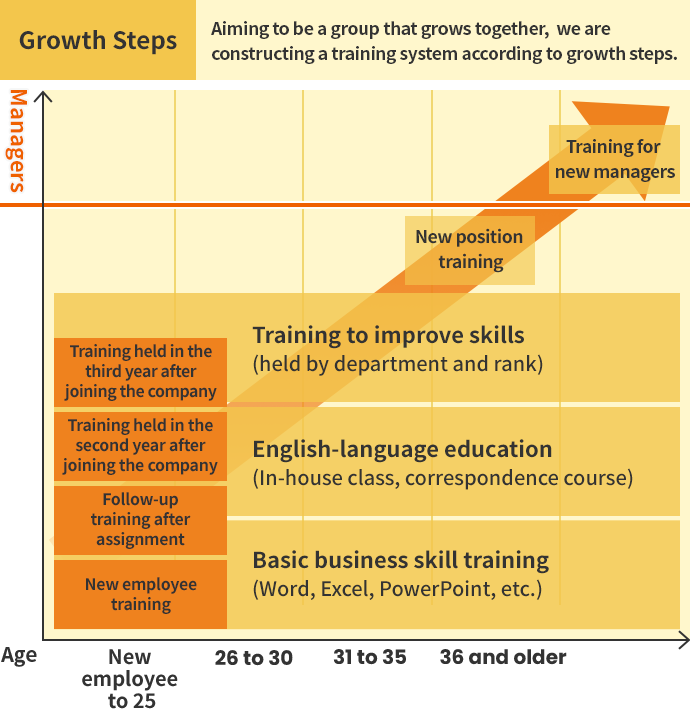
MAX has established a training system which enables human resources to grow in gradual steps, from team members who contribute to their teams to leaders who direct their teams. In particular, our "essay test" is a unique system that leads to the cultivation of human resources only found at MAX.
As part of our examination for promotion, MAX asks employees to write an essay on the theme of "working as a team to solve problems." The essay calls for a practical description focused on "Do, See, Think."
Supervisors are always expected to provide subordinates with opportunities to practice teamwork based on known facts.
Fair Evaluation and Treatment
MAX operates a fair evaluation system designed to ascertain the strengths and weaknesses of our employees and to allow employees to grow while maximizing their abilities. For personnel evaluations, we have introduced a self-assessment system in which self-assessments are carried out twice a year. First, the employee writes a detailed, objective, and fact-based description of the status of implementations for his or her own goals during the half-year period. The employee then discusses and reviews the description together with his or her supervisor. MAX places great importance on feedback that leads to the growth of our employees. The supervisors provide feedback on evaluations of results and processes, thus facilitating future skills development and growth of individual abilities. By fairly ascertaining and treating the abilities and achievements of each employee and linking them to future growth, MAX fosters motivation and fulfillment for employees. In this way, we value human growth.
In addition, on the basis of the MAX Fundamental Management Policy of "We strive to ensure management promises that company results are fairly shared by all stakeholders," we emphasize profits in our core business and have established a bonus system linked to consolidated operating income. The total source of bonuses for officers and employees is 28% of the profit distribution derived from performance results and calculated from the amount of consolidated operating income. Profits are returned to officers and employees by calculating bonuses based on internal rules.
Active Participation by Diverse Human Resources (initiatives to promote diversity)
MAX recognizes the importance of incorporating diverse human resources and values, and utilizing those resources and values to create new value. Following this belief, MAX is working to promote diversity.
We hire regardless of gender and nationality, and foreign nationals contribute to the growth of our business. In addition, our overseas subsidiaries actively hire local human resources,ensuring the multinational diversity of the Group. We carry out mid-career hires (skilled-specialist hires) based on the needs of the organization at any given time. As of March 2025, midcareer hires accounted for 13.8% of our workforce.
To promote the active participation of women, we aim for a female recruitment ratio of 20% for new graduates. In fiscal 2024, 12 of 39 new graduates were female. Moreover, as more women enter science fields, we continue to hire more women with a background in science. As for women in management positions, the percentage in the Group is 8.5% (as of March 31, 2025). We are focusing on improving this number, targeting a percentage of 10% of management positions being held by women by 2030.
Regarding employment of older people, even after the retirement age of 60, MAX employees can continue working until 65. We continue employment for nearly 100% of employees who wish to keep on working.
The employment rate of persons with disabilities was 2.7% in fiscal 2024.
Promotion of Work-Life Balance
MAX is enhancing our efforts to achieve a work-life balance to create an environment where diverse human resources can work comfortably and maximize their abilities. At the same time, we are recommending well-balanced work styles. As measures for promoting work-life balance, we have introduced a flextime system and an hourly paid-leave system. We also offer reduced working hours after childcare leave until the time children enter junior high school. Furthermore, we operate a system in which employees must apply to use their computer after 7:00 p.m.
The average total annual working hours in fiscal 2024 was 1,891 hours, and the annual paid-leave usage rate exceeded 65%.
Initiatives to Create a Healthy and Comfortable Working Environment
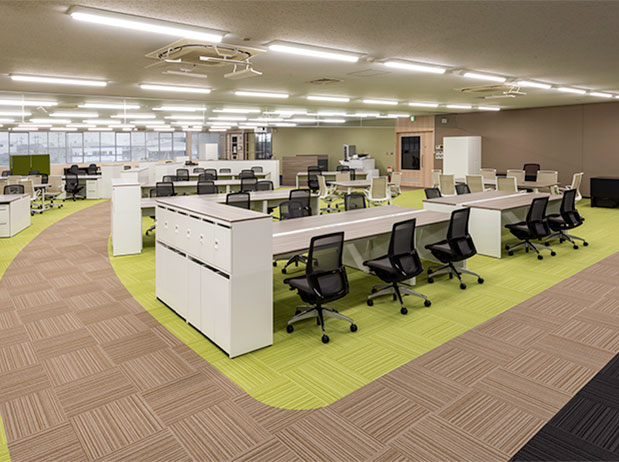
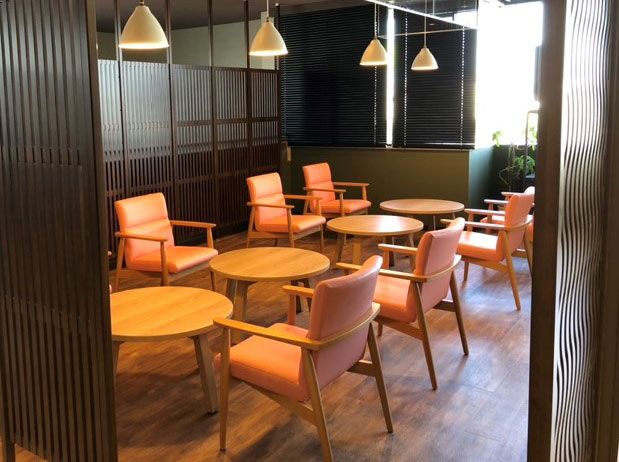
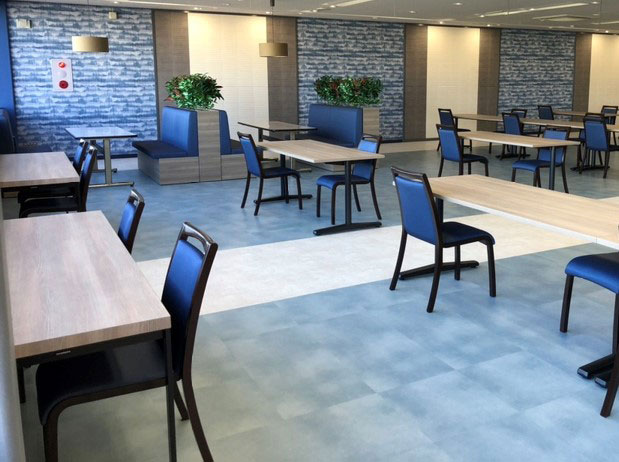
To create a healthy and comfortable working environment, MAX has improved the environment of offices and employee cafeterias. We also promote "self-checks" by employees every year and have a consultation desk staffed by industrial physicians and external experts for providing mental health care. The most recent self-checks for department managers and other managers covered self-checks on the Group Employee Code of Conduct, conduct required of department managers, and harassment.
General employees conducted self-checks on the Group Employee Code of Conduct, whistleblowing, and time management.
Initiatives for Healthy Labor-Management Relations
MAX possesses two labor unions: the MAX Industrial Labor Union (manufacturing sites) and the MAX Manufacturing and Sales Labor Union (sales offices). The personnel department shares important issues such as annual working hours with each labor union, and holds periodic meetings on the progress of activities to maintain sound labor-management relations while periodically exchanging opinions.
Guarantee of Minimum Wage
MAX Group domestic companies pay wages that exceed the regional and industry minimum wages as stipulated by the Minimum Wage Act.
Our overseas group companies also set employee wages based on the minimum wage laws and regulations of each country, and comply with all applicable and regulations.
Human Resources Data
| Item | Breakdown | Unit | FY 2024 |
FY 2023 |
FY 2022 |
FY 2021 |
FY 2020 |
|
| Employee status | Number of employees | People | 999 | 979 | 976 | 971 | 953 | |
| Men | People | 891 | 882 | 887 | 888 | 876 | ||
| Male ratio | % | 89.2 | 90.1 | 90.9 | 91.5 | 91.9 | ||
| Women | People | 108 | 97 | 89 | 83 | 77 | ||
| Female ratio | % | 10.8 | 9.9 | 9.1 | 8.5 | 8.1 | ||
| Average age of employees | Age | 41.3 | 41.8 | 42.2 | 42.7 | 42.9 | ||
| Men | Age | 42.3 | 42.7 | 43.1 | 43.6 | 43.7 | ||
| Women | Age | 33.6 | 33.5 | 33.6 | 33.3 | 33.6 | ||
| Average years of service for employees | Years | 16.3 | 16.9 | 17.2 | 17.6 | 17.6 | ||
| Men | Years | 17.1 | 17.7 | 17.9 | 18.3 | 18.2 | ||
| Women | Years | 9.4 | 9.7 | 10.0 | 9.7 | 10.3 | ||
| New hires | People | 39 | 34 | 37 | 39 | 41 | ||
| Men | People | 27 | 30 | 30 | 34 | 31 | ||
| Male ratio | % | 69.2 | 73.5 | 81.1 | 87.2 | 75.6 | ||
| Women | People | 12 | 9 | 7 | 5 | 10 | ||
| Female ratio | % | 30.8 | 26.5 | 18.9 | 12.8 | 24.4 | ||
| Average salary | Thousand yen | 9,339 | 9,445 | 8,116 | 8,142 | 7,850 | ||
| Number of employees with disabilities | People | 22 | 21 | 18 | 18 | 18 | ||
| Employment ratio of people with disabilities | % | 2.7 | 2.5 | 2.3 | 2.3 | 2.2 | ||
| (Reference) | Part-time workers | People | 258 | 259 | 279 | 281 | 286 | |
| Men | People | 43 | 42 | 47 | 47 | 45 | ||
| Male ratio | % | 16.7 | 16.2 | 16.8 | 16.7 | 15.7 | ||
| Women | People | 215 | 217 | 232 | 234 | 241 | ||
| Female ratio | % | 83.3 | 83.8 | 83.2 | 83.3 | 84.3 | ||
| Composition of managers | Number of managers | People | 259 | 260 | 263 | 265 | 254 | |
| Men | People | 254 | 257 | 260 | 262 | 251 | ||
| Male ratio | % | 98.1 | 98.8 | 98.9 | 98.9 | 98.8 | ||
| Women | People | 5 | 3 | 3 | 3 | 3 | ||
| Female ratio | % | 1.9 | 1.2 | 1.1 | 1.1 | 1.2 | ||
| Childcare leave | Number of employees taking childcare leave | People | 16 | 18 | 14 | 5 | 4 | |
| Men | People | 13 | 14 | 7 | 5 | 1 | ||
| Women | People | 3 | 4 | 7 | 0 | 3 | ||
| Usage ratio of childcare leave by male employees | ||||||||
| ※2 | % | 81.3 | 60.0 | 35.0 | - | - | ||
| ※3 | % | 100.0 | 88.0 | 90.0 | - | - | ||
| Return to work rate for employees who took childcare leave | ||||||||
| Men | % | 100.0 | 100.0 | 100.0 | 100.0 | 100.0 | ||
| Women | % | 100.0 | 100.0 | 100.0 | 100.0 | 100.0 | ||
| Nursing care leave | Number of employees taking nursing care leave | People | 0 | 0 | 0 | 0 | 0 | |
| Men | People | |||||||
| Women | People | |||||||
| Total working hours | Average total annual working hours | Hours | 1,891 | 1,879 | 1,901 | 1,941 | 1,929 | |
| Annual paid leave | Paid leave usage ratio | % | 65,6 | 68.4 | 61.4 | 57.6 | 51.8 | |
| Number of days of paid leave taken | Days | 13.6 | 14.4 | 13.8 | 13.0 | 11.8 | ||
| Overtime hours | Average annual overtime hours | Hours | 161 | 160 | 178 | 206 | 194 | |
| Turnover | Turnover rate (including retirees) | % | 0.8 | 1.9 | 2.2 | 1.9 | 1.8 | |
| Labor union | Number of union members | People | 692 | 698 | 695 | 685 | 672 | |
*1 Data categories are for MAX Co.,Ltd.(non-consolidated).
*2 Usage rate of childcare leave as defined in Article 71-6, Item 1 of the Ordinance for Enforcement of the Act on Childcare Leave, Caregiver Leave, and Other Measures for the Welfare of Workers Caring for Children or Other Family Members (Ordinance of the Ministry of Labor No. 25 of 1991)
*3 Usage rate of childcare leave and leave for childcare purposes as defined in Article 71-6, Item 2 of the Ordinance for Enforcement of the Act on Childcare Leave, Caregiver Leave, and Other Measures for the Welfare of Workers Caring for Children or Other Family Members (Ordinance of the Ministry of Labor No. 25 of 1991)